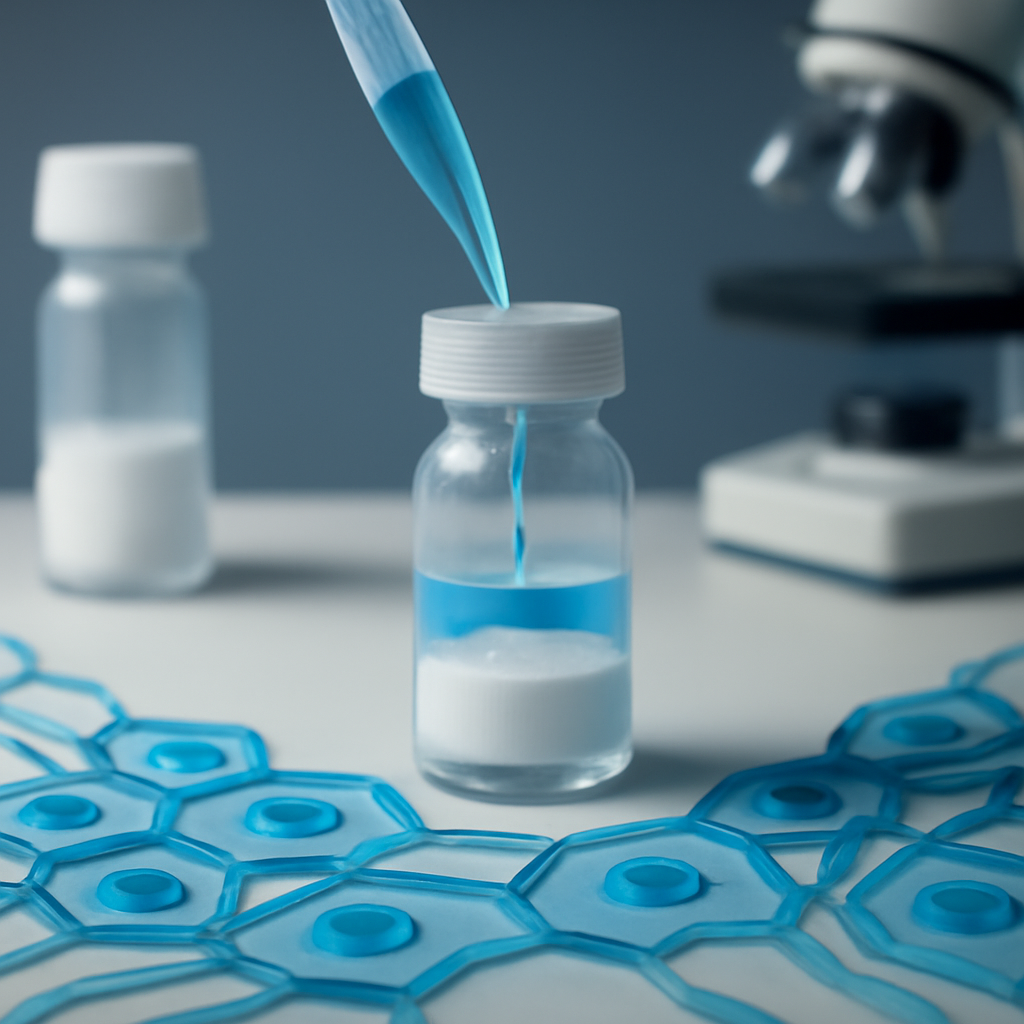
Why Reconstitution Technique Actually Matters
Peptides are short-chain amino acid sequences — typically 2 to 50 residues — held together by peptide bonds that are far more fragile than the covalent backbone of small-molecule pharmaceuticals. When researchers ask how do you reconstitute peptides, the answer goes beyond simply "add water." Incorrect solvent choice, aggressive agitation, or improper injection angle can break those bonds, aggregate the protein structure, or introduce microbial contamination that renders the entire vial useless.
This guide walks through every variable that determines whether your reconstituted peptide retains full biological activity: solvent selection, volume math, injection mechanics, mixing technique, and cold-chain storage. All protocols described here are referenced from published literature and are framed for laboratory research purposes only — these compounds are not approved for human consumption.
Solvent Selection: Bacteriostatic Water vs. Sterile Water
The single most important decision in peptide reconstitution is solvent choice. Two options dominate research use:
- Bacteriostatic water (BW): 0.9% benzyl alcohol in sterile water. The benzyl alcohol acts as a preservative, inhibiting bacterial proliferation and extending the usable shelf life of a reconstituted vial to approximately 28 days when refrigerated at 2–8°C.
- Sterile water for injection: Contains no preservative. Post-reconstitution shelf life drops to 3–5 days refrigerated. Appropriate for single-use scenarios or for peptides sensitive to benzyl alcohol (rare, but documented for some extremely hydrophobic sequences).
Acetic acid (0.1–1%) is occasionally specified for peptides that are poorly soluble in aqueous solutions alone — certain growth hormone fragments and some lipidated analogs fall into this category. When acetic acid is used as a co-solvent, dilution with bacteriostatic water to the target concentration is the standard follow-up step.
How Do You Reconstitute Peptides: The Full Step-by-Step Protocol
The following procedure represents standard laboratory practice for peptide reconstitution. Each step addresses a specific failure mode — skip one and you risk compromising the batch.
- Temperature equilibration (10–15 minutes): Remove both the lyophilized peptide vial and the bacteriostatic water from cold storage. Allow both to reach room temperature before proceeding. Injecting cold solvent into a room-temperature vial — or vice versa — can create thermal stress on the peptide matrix and cause localized aggregation.
- Surface sanitization: Wipe the rubber septum of both vials with a 70% isopropyl alcohol prep pad. Allow to air-dry for 15–20 seconds. Do not blow on the surface or touch the sanitized area.
- Draw your solvent volume: Using a clean insulin syringe or reconstitution syringe, draw the calculated volume of bacteriostatic water. (See concentration math below.) Use our peptide calculator to verify your target volume before drawing.
- Sidewall injection — this step is critical: Insert the needle through the peptide vial's septum at an angle so the tip touches the inside glass wall. Depress the plunger slowly, letting the water run down the side of the glass rather than jetting directly onto the lyophilized cake. Direct impingement disrupts the organized peptide matrix and accelerates denaturation.
- Gentle mixing: Once all solvent is added, gently swirl the vial in slow circular motions for 30–60 seconds. If the powder does not fully dissolve, allow the vial to sit at room temperature for an additional 5 minutes, then swirl again. Never vortex or shake a peptide vial — mechanical shear forces break peptide bonds and create particulate aggregates.
- Visual inspection: The solution should be clear and colorless (or very faintly yellow for some peptides). Cloudiness, visible particles, or unusual color indicates contamination or denaturation — discard the vial.
- Label and refrigerate: Label the vial with the peptide name, concentration, reconstitution date, and expiry (28 days if bacteriostatic water was used). Store upright at 2–8°C. Do not freeze reconstituted peptides.
Concentration Math: How Do You Reconstitute Peptides for Accurate Dosing
Getting the concentration calculation right is where most errors occur in research settings. The math is straightforward once you establish the formula:
Concentration (mcg/mL) = Peptide mass (mcg) ÷ Solvent volume (mL)
Working examples researchers commonly reference:
- 5 mg vial + 2 mL bacteriostatic water: 5,000 mcg ÷ 2 mL = 2,500 mcg/mL. A 250 mcg research dose requires drawing 0.10 mL (10 units on a U-100 insulin syringe).
- 5 mg vial + 1 mL bacteriostatic water: 5,000 mcg ÷ 1 mL = 5,000 mcg/mL. A 250 mcg dose requires 0.05 mL (5 units). Higher concentration — useful for minimizing injection volume.
- 2 mg vial + 1 mL bacteriostatic water: 2,000 mcg ÷ 1 mL = 2,000 mcg/mL. A 200 mcg dose requires 0.10 mL (10 units).
For peptides commonly used in musculoskeletal repair research such as BPC-157, a 5 mg vial reconstituted with 2 mL bacteriostatic water provides approximately 20 research doses at 250 mcg each. For growth hormone secretagogue research involving peptides like Ipamorelin, the same math applies — always verify with the peptide calculator before proceeding.
Research Dosing Protocols: Common Reference Points
The following dosing ranges are drawn from published pre-clinical and early-phase clinical literature and represent what investigators have used in controlled research settings. They are not treatment recommendations.
| Peptide | Research Dose Range | Frequency (Published Protocols) | Route |
|---|---|---|---|
| BPC-157 | 250–500 mcg | Once or twice daily | Subcutaneous / IP |
| Ipamorelin | 100–300 mcg | 2–3× daily | Subcutaneous |
| CJC-1295 DAC | 1–2 mg | Once or twice weekly | Subcutaneous |
| TB-500 | 2.5–5 mg (loading) | Twice weekly (loading phase) | Subcutaneous / IV |
CJC-1295 without DAC has a substantially shorter half-life (~30 minutes) compared to the DAC version (~8 days), which is why dosing frequency differs so dramatically. When stacking CJC-1295 (DAC) with Ipamorelin in research, the complementary mechanisms — GHRH analog driving sustained GH output, GHRP amplifying pulsatile release — are well documented in the pituitary physiology literature (Teichman et al., 2006).
How Do You Reconstitute Peptides for Long-Term Storage Projects
Research programs running multi-week protocols need a storage strategy that extends beyond the 28-day reconstituted window. Key principles:
- Lyophilized (dry) peptides: Store at –20°C for up to 24 months; some sequences remain stable at 4°C for 6–12 months if kept dessicated and away from light. Do not reconstitute until needed.
- Reconstituted peptides (bacteriostatic water): 2–8°C, maximum 28 days. Minimize freeze-thaw cycling — each cycle degrades peptide integrity by an estimated 5–15% depending on sequence and formulation.
- Avoid light exposure: UV radiation cleaves peptide bonds. Amber vials or foil-wrapped storage significantly extends active half-life.
- Aliquoting for large batches: For peptides used in repeat-measure designs, consider reconstituting at a higher concentration and aliquoting into multiple small vials to reduce repeated needle penetration of a single septum (contamination risk increases with each puncture).
Peptide Stacking: Reconstitution Logistics for Multi-Compound Protocols
When research designs involve more than one peptide simultaneously, reconstitution logistics become more complex. Two common research stacks illustrate the practical considerations:
BPC-157 + TB-500
BPC-157 addresses localized tissue repair through upregulation of growth factor receptors (notably VEGFR2) and nitric oxide signaling, while TB-500 (the synthetic fragment of Thymosin Beta-4) acts systemically to promote actin polymerization and cell migration. In a loading-phase protocol, researchers have used 250–500 mcg of BPC-157 daily alongside 2.5–5 mg of TB-500 twice weekly. These are reconstituted separately — do not combine lyophilized peptides in a single vial unless the formulation is specifically designed for co-lyophilization.
CJC-1295 + Ipamorelin
The GHRH/GHRP combination leverages two independent receptor pathways: CJC-1295 binds GHRH receptors on somatotroph cells; Ipamorelin activates the ghrelin receptor (GHS-R1a). The result is amplified GH pulse amplitude without a corresponding cortisol or prolactin spike — a profile that distinguishes Ipamorelin from earlier GHRPs like GHRP-6. Both peptides are reconstituted separately and may be drawn into the same syringe immediately before research administration if concentrations allow for the volumes involved.
Common Reconstitution Errors and How to Avoid Them
- Using tap water or non-sterile saline: Introduces microbial and ionic contamination that degrades peptide integrity within hours.
- Injecting directly onto the powder cake: Creates localized high-solvent concentration that denatures the outer peptide layer before it can dissolve.
- Shaking the vial: Generates foam and mechanical shear. Aggregated peptides cannot be disaggregated — the batch is effectively destroyed.
- Freezing reconstituted peptides: Ice crystal formation physically ruptures peptide tertiary structure. Lyophilized form is what survives freeze-drying; reconstituted form is not designed for it.
- Using the wrong syringe gauge: Large-bore needles (below 25G) introduce unnecessary air and can cause coring of the rubber septum, introducing particulates. Standard research use: 27–29G, 0.5 inch.
Research Use Only Disclaimer: All peptides referenced in this article are intended solely for in vitro and pre-clinical laboratory research. They are not approved by the FDA for human consumption, therapeutic use, or veterinary administration. Capital Peptides supplies research-grade compounds to qualified researchers in compliance with applicable regulations. Nothing in this article constitutes medical advice or a recommendation for human self-administration.
Frequently Asked Questions
How much bacteriostatic water do you add when reconstituting peptides?
The volume depends on your target concentration. A common research standard is adding 1–2 mL of bacteriostatic water to a 5 mg vial, yielding 5,000 mcg/mL or 2,500 mcg/mL respectively. Use the peptide calculator to determine the exact volume needed for your specific dose and vial size.
Can you use sterile water instead of bacteriostatic water to reconstitute peptides?
Yes, but reconstituted peptides in sterile water must be used within 3–5 days because there is no preservative to inhibit bacterial growth. Bacteriostatic water (0.9% benzyl alcohol) extends shelf life to approximately 28 days refrigerated and is the preferred solvent for most multi-draw research protocols.
Why shouldn't you shake a peptide vial after adding water?
Mechanical agitation from shaking generates foam and applies shear force to the peptide's fragile molecular structure, causing irreversible aggregation and denaturation. Gentle swirling for 30–60 seconds is sufficient to dissolve most lyophilized peptides without compromising structural integrity.
How long do reconstituted peptides last in the refrigerator?
Reconstituted peptides stored in bacteriostatic water at 2–8°C remain stable for up to 28 days. Peptides reconstituted in sterile water should be used within 3–5 days. Lyophilized (dry) peptides stored at –20°C can remain stable for up to 24 months.
Can you reconstitute two different peptides together in one vial?
Generally, no — peptides should be reconstituted separately unless they have been specifically co-lyophilized together during manufacturing. Mixing two individually reconstituted peptides in the same syringe immediately before use is a common research practice and carries less risk than combining them in a single storage vial.
References
- Sievers, S.A. et al. (2011). "Structure-based design of non-natural amino-acid inhibitors of amyloid fibril formation." Nature, 475, 96–100. Foundational work on peptide structural stability and aggregation mechanisms relevant to reconstitution technique. nature.com
- Teichman, S.L. et al. (2006). "Prolonged stimulation of growth hormone (GH) and insulin-like growth factor I secretion by CJC-1295, a long-acting analog of GH-releasing hormone, in healthy adults." Journal of Clinical Endocrinology & Metabolism, 91(3), 799–805. Reference for CJC-1295 dosing frequency and half-life data. academic.oup.com
- Chang, C.H. et al. (2011). "The promoting effect of pentadecapeptide BPC 157 on tendon healing involves tendon outgrowth, cell survival, and cell migration." Journal of Applied Physiology, 110(3), 774–780. Documents BPC-157 mechanism of action in tissue repair contexts. journals.physiology.org
- Goldstein, A.L. et al. (2012). "Thymosin β4: a multi-functional regenerative peptide. Basic properties and clinical applications." Expert Opinion on Biological Therapy, 12(1), 37–51. Covers TB-500 (Thymosin Beta-4 fragment) mechanisms relevant to tissue repair stacking protocols. tandfonline.com
- U.S. Pharmacopeia (USP). (2023). "General Chapter <797> Pharmaceutical Compounding — Sterile Preparations." Standards governing bacteriostatic water formulation, sterility testing, and beyond-use dating for reconstituted sterile preparations. usp.org