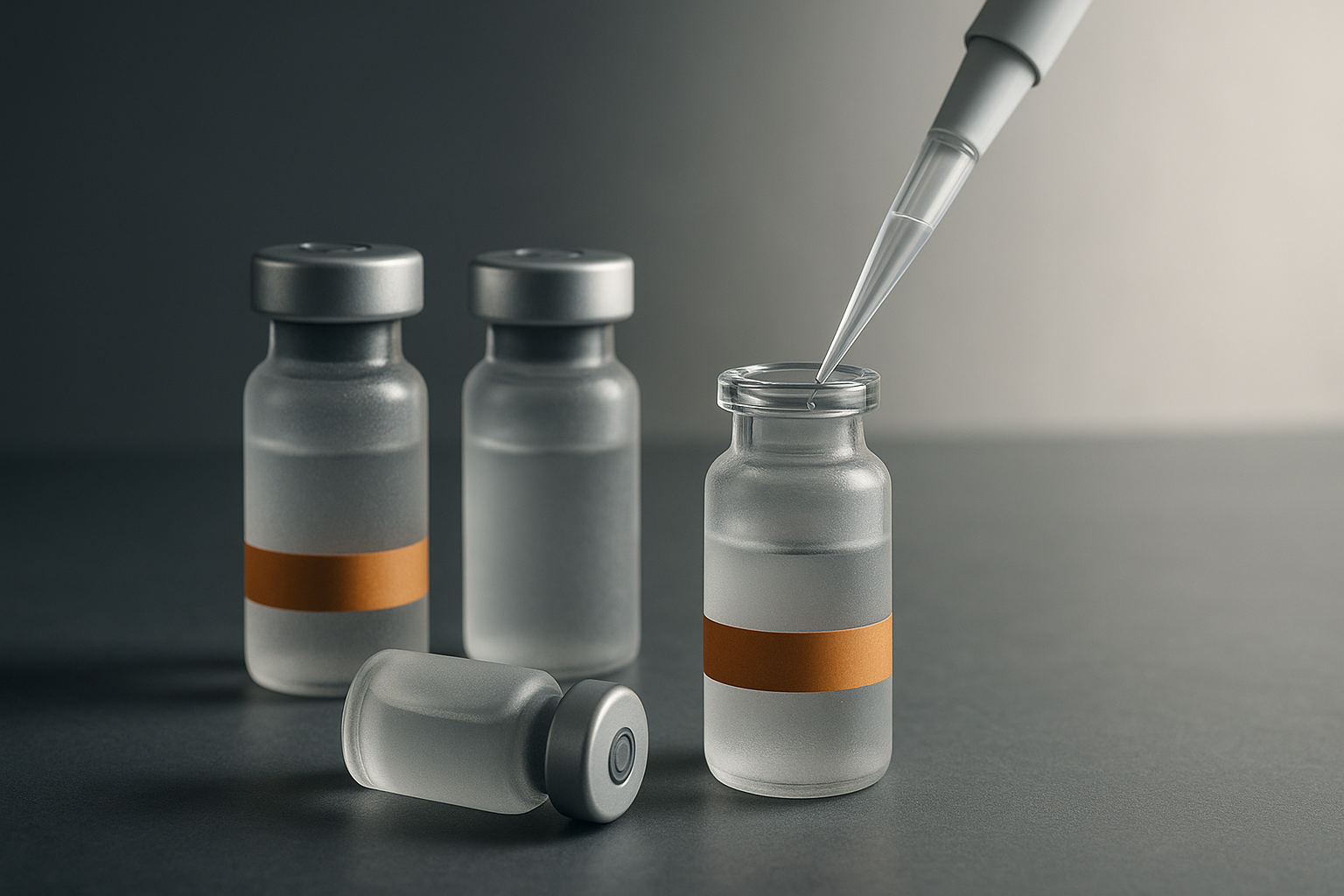
Math is only half of peptide reconstitution. The other half is technique — if you hit a lyophilized peptide pellet with a hard jet of water or let it sit at room temperature for a week, your carefully calculated dose no longer means anything. This guide covers the practical side.
For the arithmetic behind draw volumes and syringe units, see our full calculator guide.
What you need
- Lyophilized peptide vial — sealed, stored frozen until use.
- Bacteriostatic water — sterile water with 0.9% benzyl alcohol. Not sterile water. Not tap water. Not saline.
- Reconstitution syringe — a 1 ml or 3 ml slip-tip syringe with an 18–22 gauge needle for pulling BAC water.
- Insulin syringes (U-100) — 0.3 ml or 0.5 ml, for drawing research doses after reconstitution.
- Alcohol swabs — 70% isopropyl.
- Sharps container — non-negotiable.
Step by step
1. Let the vial come to room temperature
Take the lyophilized peptide out of the freezer and let it sit on the counter for 15–20 minutes. Cold glass + warm liquid can crack a vial; cold peptide is also slightly harder to reconstitute uniformly.
2. Swab both rubber stoppers
Wipe the stopper on the bacteriostatic water vial and the stopper on the peptide vial with an alcohol swab. Let them air-dry for ~15 seconds before piercing.
3. Draw your bacteriostatic water
Use a 1 ml or 3 ml syringe with a slightly larger-bore needle (21–22g is fine). Pull the exact volume you calculated — typically 1–3 ml depending on the peptide and vial size. Check for air bubbles and tap them to the top, then expel.
4. Inject water slowly against the glass wall
This is the part most people get wrong. Insert the needle into the peptide vial at an angle and push the water slowly so it runs down the inside glass wall — not directly onto the pellet. A direct high-pressure jet onto lyophilized peptide can physically disrupt it and reduce potency.
5. Swirl, do not shake
Gently rotate the vial between your fingers for 15–30 seconds. The powder should dissolve into a clear solution (some peptides tint very slightly blue or amber — GHK-Cu will be distinctly blue from the copper complex). Shaking introduces microbubbles and shear stress that can damage the peptide.
6. Label and store
Write the reconstitution date on the vial. Store upright in the refrigerator (2–8°C). Do not freeze reconstituted peptide — freeze/thaw cycles destroy it. Use within 2–4 weeks depending on the specific peptide.
7. Draw your research dose
When drawing a dose, swab the vial stopper again, pull just slightly past your target unit line on the insulin syringe, tap out any air, and push back down to the exact line. The calculator converts your concentration and target dose into the exact IU mark to draw to.
Storage reference
| State | Temperature | Typical stability |
|---|---|---|
| Lyophilized (unreconstituted) | −20°C or colder | 12–24 months |
| Lyophilized, short-term | 2–8°C | 1–3 months |
| Reconstituted | 2–8°C | 2–4 weeks (peptide-dependent) |
| Reconstituted, room temp | 20–25°C | Hours to 1–2 days — not for storage |
Things that ruin a vial
- Using sterile water instead of bacteriostatic. Bacteriostatic water contains benzyl alcohol as a preservative. Sterile water with no preservative will grow bacteria in a multi-use vial within days.
- Freezing a reconstituted vial. Ice crystals shred the peptide. Once it's in solution, keep it cold but liquid.
- Shaking to dissolve. Swirl slowly. Aggressive shaking denatures and foams the peptide.
- Re-using needles. A used needle in a multi-use vial introduces contamination and dulls the tip.
- Touching the needle or the exposed stopper. Alcohol swab every access, every time.
Special cases
GHK-Cu
GHK-Cu reconstitutes as a distinctly blue solution — that's the copper complex, not contamination. Use within 2 weeks because the copper makes it less stable than most peptides in solution.
Melanotan II
MT-II is particularly light-sensitive. Keep the vial in its box or in an opaque container in the fridge.
Large-dose peptides (TB-500, MOTS-c, tirzepatide)
Common research doses are 2.5–5 mg, which approach the entire vial. Reconstitute in a larger volume of water (3–5 ml) if you want smaller per-draw volumes for syringe precision.
Ready to calculate your exact draw?
Open Reconstitution Calculator