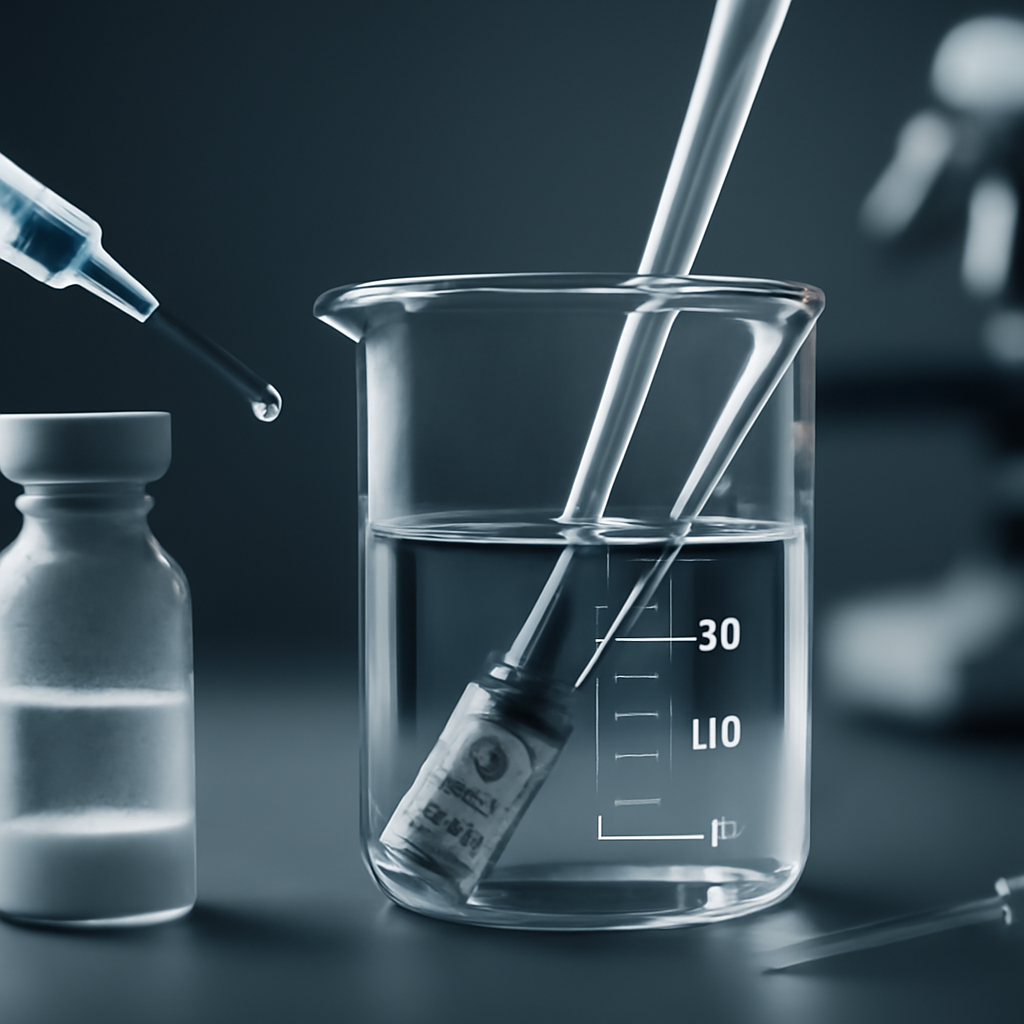
Why a Peptide Calculator for Semaglutide Matters
Semaglutide is one of the most studied GLP-1 receptor agonists in peptide research, with clinical trials documenting an average 10–15% reduction in body weight over 68 weeks and a 1.5% drop in HbA1c over 30 weeks. But those results depend on dosing precision. Unlike pre-filled autoinjector pens used in clinical settings, lyophilized semaglutide supplied for laboratory research requires manual reconstitution — and a single math error can corrupt an entire experiment.
That's where a peptide calculator for semaglutide becomes an essential tool. Rather than working backwards from concentration formulas on a whiteboard, a dedicated calculator takes your vial size, diluent volume, and target dose, then outputs the exact injection volume in both milliliters and syringe units. Use the Capital Peptides peptide calculator to run these numbers before every reconstitution.
How Semaglutide Works: Mechanism of Action
Semaglutide is a synthetic analogue of human GLP-1 (glucagon-like peptide-1), sharing approximately 94% sequence homology with the endogenous hormone. Its extended half-life of roughly 165–184 hours — compared to GLP-1's native 1–2 minutes — is achieved through two structural modifications: a C-18 fatty diacid chain attached via a linker to lysine at position 34, and an amino acid substitution (alanine to alpha-aminoisobutyric acid) at position 8 that confers resistance to DPP-4 enzymatic degradation.
In research models, these modifications enable once-weekly subcutaneous dosing while maintaining full GLP-1 receptor agonism. The downstream effects include:
- Glucose-dependent insulin secretion: Semaglutide stimulates beta-cell insulin release only in the presence of elevated blood glucose, which reduces hypoglycemic risk in isolation.
- Glucagon suppression: Inhibits alpha-cell glucagon secretion, reducing hepatic glucose output.
- Gastric emptying delay: Slows gastric motility, blunting postprandial glucose excursions and increasing satiety.
- Central appetite regulation: Acts on hypothalamic GLP-1 receptors and brainstem circuits to reduce food-seeking behavior and caloric intake.
The SUSTAIN and STEP trial series established semaglutide's efficacy benchmarks: a mean HbA1c reduction of 1.5% over 30 weeks (SUSTAIN-1) and mean body weight loss of 14.9% over 68 weeks at the 2.4 mg/week dose in non-diabetic subjects with obesity (STEP-1).
Reconstitution Protocol for Research Use
Lyophilized semaglutide powder requires careful reconstitution to preserve peptide integrity. The following protocol reflects commonly referenced laboratory practices — always cross-reference with your specific vial's certificate of analysis (CoA).
Diluent Selection
Bacteriostatic water (0.9% benzyl alcohol) is the standard diluent for research-grade semaglutide vials intended for multi-draw use. Benzyl alcohol inhibits microbial growth, extending the reconstituted peptide's refrigerated stability to approximately 28 days. Sterile water for injection is appropriate for single-use preparations only, with a much shorter post-reconstitution window (typically 24 hours).
Step-by-Step Reconstitution
- Allow the vial to equilibrate to room temperature (15–20 minutes).
- Wipe the vial stopper with a 70% isopropyl alcohol swab and allow to dry.
- Draw the target diluent volume into a sterile syringe (commonly 1–2 mL for research vials).
- Insert the needle at an angle and slowly release the diluent down the inside wall of the vial — do not inject directly onto the powder cake.
- Gently swirl (do not vortex or shake) until the powder is fully dissolved. The solution should appear clear and colorless.
- Label the vial with the reconstitution date and calculated concentration.
To avoid calculation errors — especially when working with non-standard vial sizes (2mg, 3mg, 5mg, 10mg) — run your numbers through the peptide dosing calculator before drawing any volume.
Using a Peptide Calculator for Semaglutide: Step-by-Step
A peptide calculator for semaglutide requires three inputs to return a usable injection volume:
- Vial peptide amount (mg): The total mass of semaglutide in the vial (e.g., 2 mg, 5 mg, 10 mg).
- Diluent volume added (mL): How much bacteriostatic water you added during reconstitution.
- Target research dose (mg): The dose specified in the protocol you're following (e.g., 0.25 mg, 0.5 mg, 1.0 mg).
The calculator then outputs the draw volume in both mL and insulin syringe units. Here's an example table for a commonly used 5 mg vial reconstituted with 2 mL bacteriostatic water (resulting concentration: 2.5 mg/mL):
| Research Dose (mg) | Draw Volume (mL) | U-100 Syringe Units |
|---|---|---|
| 0.25 mg | 0.10 mL | 10 units |
| 0.50 mg | 0.20 mL | 20 units |
| 1.00 mg | 0.40 mL | 40 units |
| 2.40 mg | 0.96 mL | 96 units |
If you reconstitute the same 5 mg vial with 1 mL instead of 2 mL, your concentration doubles to 5 mg/mL, and every draw volume is halved. This is exactly the kind of scenario where manual calculation fails and a dedicated peptide calculator prevents protocol drift.
Semaglutide Research Dosing Protocols
The following dosing information reflects commonly referenced research protocols cited in published literature and is provided for laboratory reference only. It does not constitute medical advice or a clinical recommendation.
The standard titration referenced across SUSTAIN and STEP trial frameworks begins at 0.25 mg once weekly for four weeks — a sub-therapeutic dose designed to establish gastrointestinal tolerance — then escalates to 0.5 mg for weeks 5–8. Depending on the study endpoint, dosing may remain at 0.5 mg (standard glycemic control protocols) or continue escalating to 1.0 mg (maintenance for metabolic studies) and ultimately 2.4 mg/week (the high-dose obesity protocol used in STEP-1).
Weekly subcutaneous administration is the predominant delivery route in research contexts. As of 2026, oral semaglutide formulations have received expanded regulatory attention, with bioavailability data showing roughly 1% oral absorption — necessitating significantly higher oral doses (7 mg and 14 mg tablets in clinical settings) to achieve comparable systemic exposure.
Safety Profile and Observed Side Effects
Published research reports the following adverse event profile for semaglutide at therapeutic doses:
- Gastrointestinal events (most common): Nausea occurs in approximately 20% of subjects, vomiting in 10%, and diarrhea in 15%. These events are most frequent during the dose-titration phase and typically attenuate within 4–8 weeks.
- Hypoglycemia: Low risk in monotherapy; risk increases when combined with insulin secretagogues or exogenous insulin in research models.
- Pancreatitis: Rare reported cases in post-marketing surveillance; flagged for monitoring in preclinical and clinical research designs.
- Thyroid C-cell effects: Rodent studies identified dose-dependent thyroid C-cell tumors; human relevance remains under investigation. Ongoing 5-year follow-up data (published through 2026) has not confirmed this effect in human subjects.
- Injection site reactions: Mild erythema or bruising at subcutaneous injection sites; generally transient.
Semaglutide in Research Stacks
In metabolic research models, semaglutide has been examined alongside other agents. These combinations are not endorsements — they reflect what appears in peer-reviewed research contexts:
- Semaglutide + Metformin: Additive reductions in fasting plasma glucose and HbA1c observed in combination arms of SUSTAIN trials, without significant increase in hypoglycemic episodes.
- Semaglutide + SGLT2 inhibitors (e.g., empagliflozin): Enhanced glycosuric weight loss and cardiovascular risk reduction in combined-mechanism studies.
- Semaglutide + Tirzepatide comparison: While tirzepatide (a dual GIP/GLP-1 agonist) has demonstrated superior weight loss endpoints in head-to-head SURMOUNT versus SUSTAIN comparisons, semaglutide maintains a well-characterized safety and pharmacokinetic profile, making it a common reference comparator in GLP-1 receptor research.
Storage After Reconstitution
Reconstituted semaglutide should be stored in a refrigerator at 2–8°C (36–46°F). Do not freeze. When bacteriostatic water is used as the diluent, the reconstituted solution remains stable for up to 28 days under refrigerated conditions. Lyophilized (unreconstituted) vials should be stored at –20°C for long-term archival, or at 2–8°C for near-term use.
Protect from light. Inspect each vial for particulates or discoloration before drawing — discard any vial showing cloudiness, visible particles, or color change. Proper storage is as important as accurate dosing; a correctly calculated dose drawn from a degraded vial produces unreliable data.
Comparing Semaglutide to Other GLP-1 Receptor Agonists
Semaglutide's structural modifications give it a pharmacokinetic edge over earlier GLP-1 agonists used as research comparators:
- vs. Liraglutide: Once-daily liraglutide (Victoza/Saxenda) achieves 5–7% mean weight loss vs. semaglutide's 10–15% at equivalent timepoints. Semaglutide's once-weekly dosing also reduces protocol complexity in longitudinal studies.
- vs. Exenatide: Twice-daily exenatide shows inferior HbA1c reduction in head-to-head SUSTAIN-3 data. Extended-release exenatide weekly is more comparable but still trails semaglutide on weight endpoints.
- vs. Tirzepatide: The GIP/GLP-1 dual agonist tirzepatide has demonstrated 20–22% mean body weight reduction in SURMOUNT-1, outpacing semaglutide's 14.9% benchmark at high doses — though semaglutide's longer track record provides more robust long-term safety data through 2026 five-year follow-up studies.
Research Use Only Disclaimer: Semaglutide and all peptides referenced on this page are intended solely for laboratory research purposes. They are not approved for human consumption, self-administration, or clinical use outside of properly supervised medical settings. Capital Peptides products are sold exclusively for in vitro and preclinical research applications.
---Frequently Asked Questions
How do I use a peptide calculator for semaglutide with a 5 mg vial?
Enter 5 mg as the vial amount, your chosen diluent volume (e.g., 2 mL of bacteriostatic water), and your target dose (e.g., 0.25 mg). The calculator returns 0.10 mL, or 10 units on a U-100 insulin syringe. Use the Capital Peptides calculator to handle any vial size or dose combination automatically.
What diluent should be used to reconstitute semaglutide for research?
Bacteriostatic water (0.9% benzyl alcohol) is the standard choice for multi-draw research vials, offering up to 28 days of stability at 2–8°C. Sterile water for injection is appropriate only for single-use preparations, with a 24-hour post-reconstitution window.
What is the typical semaglutide dosing titration used in research protocols?
Published research protocols commonly begin at 0.25 mg once weekly for four weeks (tolerance phase), escalate to 0.5 mg for weeks 5–8 (titration), then maintain at 0.5–1.0 mg weekly. The STEP-1 trial used 2.4 mg/week as its high-dose endpoint over 68 weeks. These are research reference figures, not clinical prescriptions.
How does semaglutide compare to tirzepatide in research models?
Tirzepatide's dual GIP/GLP-1 mechanism produced approximately 20–22% mean weight loss in SURMOUNT-1 vs. semaglutide's ~14.9% in STEP-1. However, semaglutide has a longer published safety dataset, including five-year follow-up data available as of 2026, making it a well-characterized reference comparator in metabolic research.
How long does reconstituted semaglutide remain stable?
When reconstituted with bacteriostatic water and stored at 2–8°C, semaglutide solution is generally stable for up to 28 days. Freezing the reconstituted solution can cause peptide aggregation and should be avoided. Always inspect for particulates or discoloration before each use.
References
- Wilding, J.P.H., et al. (2021). "Once-Weekly Semaglutide in Adults with Overweight or Obesity" (STEP-1 Trial). New England Journal of Medicine, 384, 989–1002. Documented 14.9% mean body weight reduction over 68 weeks at 2.4 mg/week. nejm.org
- Ozempic (semaglutide) Prescribing Information. (2023). Novo Nordisk. Pharmacokinetic data including half-life of 165–184 hours and structural modification rationale. novo-pi.com
- Ahmann, A.J., et al. (2018). "Efficacy and Safety of Once-Weekly Semaglutide versus Exenatide ER in Subjects with Type 2 Diabetes" (SUSTAIN-3). Diabetes Care, 41(2), 258–266. Semaglutide demonstrated superior HbA1c and weight reduction versus extended-release exenatide. diabetesjournals.org
- Jastreboff, A.M., et al. (2022). "Tirzepatide Once Weekly for the Treatment of Obesity" (SURMOUNT-1). New England Journal of Medicine, 387, 205–216. Tirzepatide achieved 20.9% weight loss at 15 mg dose, providing benchmark comparison to semaglutide endpoints. nejm.org
- Marso, S.P., et al. (2016). "Semaglutide and Cardiovascular Outcomes in Patients with Type 2 Diabetes" (SUSTAIN-6). New England Journal of Medicine, 375, 1834–1844. Reported 26% reduction in major adverse cardiovascular events vs. placebo. nejm.org